
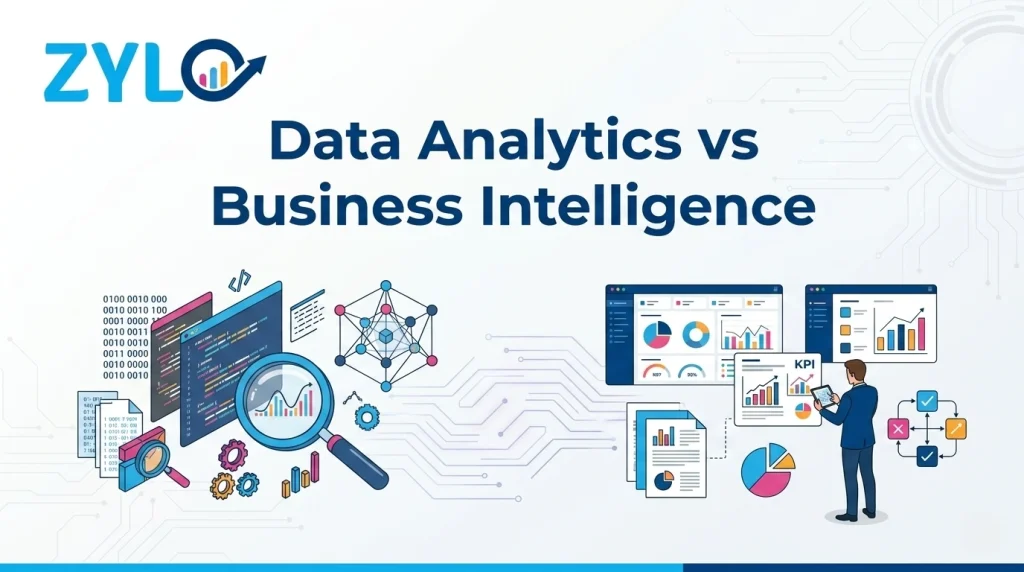
Data analytics vs business intelligence is one of the most searched comparisons in the data strategy space. Both disciplines shape how organizations make decisions, yet they operate at entirely different levels of depth, timing, and purpose. Business intelligence answers the questions you already know to ask: What happened last quarter? Where are we underperforming? Data analytics tackles the questions you haven’t thought to ask yet. It uncovers hidden patterns, predicting future outcomes, and prescribing the actions that create competitive advantage.
This guide covers everything: clear definitions, side-by-side differences, real-world examples, a full breakdown of tools and methodologies, and a practical decision framework to help you choose or combine both. Whether you’re a business leader, analyst, or technologist, you’ll leave with a clear mental model of how these two disciplines fit together in a modern data strategy.
What Is Business Intelligence (BI)?
Business Intelligence is a technology-driven process that collects, stores, and analyzes data produced by a company’s operations to support better decision-making. It mainly answers two simple questions: “What happened?” and “How did it happen?”
BI systems rely on structured, cleaned data from internal sources like CRM platforms and ERP systems. The outputs are dashboards, scorecards, and standardized reports that track Key Performance Indicators (KPIs) and surface operational inefficiencies. BI provides precise insight into a company’s past performance to guide current decision-making confidently.
From USD 30.1 billion in 2024, the global BI market is set to catapult to USD 116.25 billion by 2033, propelled by a consistent 14.98% CAGR. That explosive growth reflects just how critical operational visibility has become for modern enterprises.
It’s built specifically for non-technical users like executives, managers, and operations staff who need quick, easy-to-understand insights without writing any code.
What Is Data Analytics (DA)?
Data Analytics is the broader science of examining raw data to uncover hidden patterns, correlations, and actionable insights using statistical and computational methods. While BI looks backward, DA looks forward.
It goes well beyond descriptive reporting. Data Analytics encompasses diagnostic, predictive, and prescriptive analytics. It deals with the “why,” “what will happen,” and “what should we do” layers of analysis. It handles unstructured and semi-structured data from diverse sources: social media, IoT sensors, customer behavior logs, and external market feeds.
The global data analytics market reached USD 94.36 billion in 2025 and is forecast to hit USD 333.99 billion by 2030, growing at a staggering CAGR of 29%. The fastest-growing segment of it is predictive analytics. That tells you exactly where business priorities are shifting.
Data Analytics is the field of data scientists, statisticians, and technical analysts. They use tools like Python, R, and Apache Spark to build models. These models do more than describing reality. They simulate future scenarios and recommend the best course of action.
Data Analytics vs Business Intelligence: Key Differences Explained
These two disciplines share common DNA but serve very different strategic purposes. Here are the key differences:
1. Temporal Orientation
BI acts as a rearview mirror. It analyzes historical and current data to establish performance baselines and catch operational red flags early. Data Analytics acts as a GPS. It uses statistical modeling and advanced machine learning to forecast future outcomes and test scenarios that haven’t happened yet. One tells you what occurred; the other tells you what is coming.
2. Core Questions Answered
BI is built to answer concrete operational questions: “What is our revenue right now?” or “Where are we underperforming this quarter?”. Data Analytics digs deeper into causation and possibility: “Why did sales drop in Q3?” and “What strategies will generate 15% growth next year?” The difference sounds subtle but drives entirely different workflows, tools, and team structures.
3. Handling Data Complexity
BI primarily relies on structured data that has been cleaned and organized inside central data warehouses. Data Analytics embraces the mess. It handles unstructured data like social media text, raw sensor logs, audio transcripts, and third-party market feeds. As data diversity grows in the AI era, this distinction becomes increasingly significant.
4. Tooling and Technology Stack
The toolkits rarely overlap. BI requires commercial visualization platforms like Microsoft Power BI, Tableau, Qlik Sense, and Looker. On the other hand, Data Analytics requires the use of programming languages such as Python and R. It also uses notebooks like Jupyter. For large-scale data, it depends on tools like Hadoop and Apache Spark.
5. Impact on Strategy
BI is a tool for operational management that helps organizations replicate what works and fix immediate performance gaps. Data Analytics is the strategic brain; it informs long-term market entry decisions, uncovers innovation opportunities, and models scenarios that don’t yet exist. Organizations that use only BI optimize the present. Organizations that invest in DA build competitive advantages for the future.
| Feature | Data Analytics (DA) | Business Intelligence (BI) |
| Temporal Focus | Prospective: Future-oriented | Retrospective: Past & Present |
| Primary Questions | Why did it happen? What if? | What happened? How many? |
| Data Types | Structured, semi-structured, unstructured | Structured, cleaned internal data |
| Analytical Depth | Predictive and Prescriptive | Descriptive and Diagnostic |
| Core Tools | Python, R, SAS, Apache Spark | Power BI, Tableau, Looker, Excel |
| Scope of View | Problem-specific (granular deep-dive) | Enterprise-wide (global view) |
| Output Frequency | Ad-hoc, exploratory, predictive models | Standardized, recurring, real-time reports |
| Decision Style | Reactive: Monitoring current status | Proactive: Forecasting and optimizing |
Business Intelligence vs Data Analytics: Process, Methodology & Components
BI and DA are related disciplines that support data-driven decision-making. However, they serve different goals and follow different processes. BI looks at past and current data to track performance and understand what is happening. DA analyzes data more deeply to uncover patterns and forecast what might happen next. To use them effectively, you must understand how their processes and building blocks differ.
The Business Intelligence Process
BI runs on a repeatable cycle designed to monitor the current state of a business continuously:
1. Capture (Data Collection): Gathering structured data from internal systems such as CRM, ERP, finance platforms, and operational databases.
2. Analyze: Storing and preparing this data to understand what happened and how it unfolded.
3. Monitor: Using automated pipelines to track performance metrics in near real-time.
4. Report: Sharing findings across the organization through interactive BI dashboards and visualizations.
Key BI components include:
🡆 Data Warehousing: A centralized “single source of truth” where integrated data from multiple systems converges for analysis.
🡆 Data Visualization: Interactive dashboards, charts, and maps that make complex data digestible for non-technical users.
🡆 KPI Tracking & Scorecards: Tools that measure performance against defined benchmarks and strategic targets.
🡆 ETL (Extract, Transform, Load): The backbone process that cleans and structures raw data before it enters storage systems.
The Data Analytics Methodology
Data analysis is inherently exploratory. It typically starts with open-ended questions, hunting for unknown unknowns, insights nobody thought to look for in the first place. Underneath that curiosity, though, lies a technically rigorous methodology:
1. Data Preparation & Cleaning: Handling messy unstructured data (text, images, sensor logs) and making it ready for deep modeling.
2. Feature Selection: Identifying which specific variables carry the most predictive power for the model being built.
3. Model Building & Validation: Training algorithms on data subsets and evaluating accuracy using metrics like Mean Absolute Error (MAE) or F1-score.
4. Deployment: Moving validated models into production environments and continuously monitoring them for recalibration as new data arrives.
Key DA components include:
🡆 Statistical Modeling: Advanced mathematics, such as linear algebra and probability theory, are applied to uncover trends and hidden correlations.
🡆 Machine Learning (ML): Supervised (labeled data), unsupervised (pattern-finding), and reinforcement (reward-based) algorithms that automate insight generation at scale.
🡆 Data Mining: Sorting through massive datasets to identify hidden patterns. For example,
Market Basket Analysis reveals which products customers consistently buy together.
🡆 Big Data Technologies: Apache Spark, Hadoop, and cloud-native platforms that process petabytes of data from diverse external sources at speed.
Core Pillars of Business Intelligence and Data Analytics
BI and DA both follow a four-level analytics framework. Each level increases the depth and purpose of data analysis. You can imagine it as a pyramid where each layer rests on the one below it.
1. Descriptive Analytics answers the question, “What happened?” It transforms historical data into reports and dashboards to reveal current performance. This is the core focus of BI.
2. Diagnostic Analytics explores “Why did it happen?” by identifying patterns and relationships to uncover the root causes of issues or anomalies.
3. Predictive Analytics anticipates “What is likely to happen?” using statistical models and machine learning to forecast trends, demand, behaviors, and risks. This area is rapidly growing worldwide.
4. Prescriptive Analytics addresses “What should we do?” by recommending actions and optimizing strategies to achieve desired outcomes.
BI mainly works at the descriptive and diagnostic levels. Data Analytics goes further into predictive and prescriptive work, where strategic value increases sharply. The most advanced data-driven organizations use all four levels at the same time.
Real-World Examples of Data Analytics & Business Intelligence
Theory only goes so far. Here’s how leading companies deploy BI and DA in practice:
■ Netflix: The Power of Predictive Analytics
Netflix is one of the most cited data analytics success stories. The company uses machine learning to view data at a huge scale. Its recommendation engine now drives about 80% of all content streamed on the platform. That is not BI simply reporting what people watched. It is DA predicting and shaping what they will watch next. Netflix also uses data analytics to guide content investments. It forecasts which original shows will best retain subscribers before filming even begins. From a BI angle, Netflix relies on dashboards to track streaming quality, regional churn, and content engagement KPIs in real time. This operational visibility helps teams react to issues immediately.
■ Retail: Inventory Optimization & Market Basket Analysis
Major retailers use BI tools to track daily sales and regional performance. They also spot underperforming stores through standard dashboards. At the same time, their data analytics teams run Market Basket Analysis, a DA method that finds products often bought together. They use these insights to optimize store layouts, design targeted promotions, and cut dead stock in inventory. BI told them what sold; DA told them what to stock next to it.
■ Telecommunications: Real-Time Customer Churn Prevention
Telecom companies like Ciena use real-time data analytics to watch network performance and spot anomalies early, before customers feel any disruption. Their BI layer tracks standard KPIs such as call drop rates, data throughput, and regional outages. Their DA layer powers predictive churn models that flag customers whose behavior suggests they may cancel in 30–60 days. According to an industry report by KX and the Centre for Economics and Business Research (CEBR), businesses across six major economies could gain up to $2.6 trillion in additional revenue through investments in real-time data analytics.
■ Healthcare: BI for Compliance, DA for Outcomes
Hospitals use BI tools to monitor patient wait times, staff usage, and compliance metrics. Data analytics in healthcare goes further. It builds models to predict readmission risk. It finds patterns in unstructured clinical notes. It also suggests personalized treatments. The high stakes make the difference clear. BI focuses on monitoring. Data analytics focuses on prediction.
Data Analytics vs Business Intelligence: Which Do You Need?
Every organization faces this question eventually. The honest answer: it depends on where you are and what you need next.
Choose Business Intelligence If…
🡆 You need to track performance: BI excels at monitoring KPIs like sales by region, monthly revenue vs. target, and operational efficiency metrics through recurring automated reports.
🡆 You need a single source of truth: BI creates a governance layer ensuring “revenue” means exactly the same thing in Finance as it does in Sales.
🡆 Your users are non-technical: Executives and department heads need fast, actionable insights through intuitive dashboards. Not code or statistical models.
🡆 Your data is structured and internal: BI is purpose-built for cleaned, organized data from CRMs, ERPs, and internal databases.
🡆 You prioritize speed for recurring questions: BI automates answers to repeated tactical questions like “What is our daily revenue?” and “How are we tracking against Q2 targets?”
Choose Data Analytics If…
🡆 You want to predict future trends: DA enables demand forecasting, churn prediction, and scenario modeling that shape strategic decisions months before they must be made.
🡆 You need to answer “why” questions: BI shows what happened. DA uses statistical methods and machine learning to uncover the root causes behind those events.
🡆 You’re handling messy or diverse data: Social media sentiment, IoT sensor streams, external market feeds. DA is built for this kind of complexity.
🡆 You have a technical team: DA requires data scientists with expertise in mathematics, statistics, and programming languages like Python or R. To take advantage of data analytics without needing to hire an in-house team, you can contact us.
🡆 You seek a strategic breakthrough: DA surfaces the “unknown unknowns” — market opportunities, emerging risks, and innovation angles that standard reporting would never find.
Why Modern Businesses Need Both
BI and Data Analytics are not rivals. They form a symbiotic continuum, a complete feedback loop that drives both operational stability and strategic growth.
1. BI identifies an issue: A dashboard flags that sales in the Northeast dropped 20% last month.
2. DA investigates and predicts: An analyst identifies the root cause (a competitor launched an aggressive pricing campaign) and forecasts the revenue impact over the next two quarters.
3. DA prescribes action: The analyst recommends a targeted retention campaign with personalized offers for at-risk customers.
4. BI tracks the results: Dashboards monitor the campaign’s performance in real-time, closing the loop.
The recommended path for most organizations is straightforward. Start with BI. Build a reliable foundation of clean data and operational visibility first. Once that infrastructure is mature, layer in Data Analytics to gain a competitive edge. Skipping this foundation is a costly mistake. Data quality issues will cripple any downstream analytics effort before it even begins.
Final Words
The data analytics vs business intelligence debate isn’t really a debate; it’s a spectrum. BI gives you the operational clarity to run today’s business with confidence. Data Analytics gives you the predictive power to design tomorrow’s competitive advantage.
The organizations winning in data-driven markets aren’t choosing one over the other. They’re building integrated ecosystems where BI dashboards and advanced analytics models work in tandem.
The right starting question isn’t “Which one is better?” It’s “Which one do we need to build first?” For most organizations, the answer is BI, then DA. Get the foundation right, and the strategic layer will generate returns that compound year after year.
Don’t leave your data strategy to guesswork. Zylo delivers both BI and Data Analytics solutions under one roof — so you can move fast, build smart, and stay ahead of the competition. Start your data transformation with Zylo today.
FAQs About Business Intelligence & Data Analytics
Is data analytics business intelligence?
Not exactly. Business intelligence is a subset of data analytics focused on descriptive reporting and operational monitoring. Data analytics is the broader discipline that also includes predictive modeling, statistical analysis, and machine learning.
Can AI do business analytics?
AI can certainly help in business analytics. However, analyzing business data is a sensitive task that must be supervised by an expert human data analyst.
Can one tool do both business intelligence and data analytics?
Rarely with excellence. Modern platforms like Power BI and Tableau are adding predictive features, but most mature organizations pair a BI platform for standardized reporting with Python or R-based workflows for advanced modeling.
Is business intelligence a subset of data analytics?
Yes. BI is a specialized application of analytics focused on descriptive and operational use cases. Think of it as one lane within the broader analytics field.
How long does it take to implement BI vs. a data analytics solution?
BI tools like Tableau or Power BI can show value within weeks if clean data already exists. Data analytics initiatives, especially those involving machine learning, typically take 3–12 months, depending on data quality and team maturity.
Do small businesses need data analytics or just BI?
Most small businesses should start with BI. Get visibility into revenue, margins, and customer acquisition first. Data analytics becomes worthwhile once you have sufficient data volume and strategic questions that standard reporting can’t answer.
How do I know if my organization is ready for data analytics?
A few signals: your BI dashboards are stable and trusted, your team is asking “why” questions that reports can’t answer, and you have enough historical data to train models.
What’s the ROI difference between BI and data analytics?
BI delivers faster, more predictable ROI through operational efficiency and time saved on reporting. Data analytics ROI is higher in potential but harder to measure and slower to realize. It pays off most when tied to specific strategic outcomes like reducing churn or optimizing pricing.
Can BI and data analytics share the same data warehouse?
Yes, and they should. A shared data warehouse or lakehouse ensures both disciplines work from the same trusted data. This is one of the strongest architectural decisions an organization can make early on.